The West Virginia Connection to the P-Funk Mothership
West Virginia’s first Rock & Roll Hall of Fame inductees gained entry as founding members of Parliament-Funkadelic.
On Tuesday, May 6, 1997, the Rock & Roll Hall of Fame held its annual induction ceremony in Cleveland, Ohio—the Hall’s home city—for the first time. Since 1986, the inductions had always taken place in New York City. Among the legendary inductees that night in Cleveland were The Bee Gees, Buffalo Springfield, The Jackson 5, and Joni Mitchell.
The evening concluded with the induction of funk legends Parliament-Funkadelic. To the audience’s delight, it was none other than Prince who welcomed the band into the Hall.
Prince told the Cleveland crowd:
“I’m here to testify about Parliament-Funkadelic. The great George Clinton is the father of this funk mothership, the soulful supergroup that included a menagerie of brilliant musicians and singers who signed on for the trip. They built Parliament-Funkadelic and changed the world—my world included. They were futuristic and funky. They were earthy and from outer space at the same time.”
As Prince finished his speech and the large P-Funk aggregation gathered to receive their individual awards, two things were true, though only one was obvious: George Clinton’s Parliament-Funkadelic were now officially Rock & Roll Hall of Famers.
What was not yet apparent was that Prince had just inducted the first West Virginians into the Hall of Fame.
In the lore of the Parliament-Funkadelic conglomerate, the origin story involves five young men coming together in New Jersey (circa 1958–1961) to form a vocal group called The Parliaments. The leader, George Clinton, eventually assembled a lineup he believed in: Clinton on lead, Ray Davis on bass, Grady Thomas on baritone, and Calvin Simon and Fuzzy Haskins on first and second tenor, respectively. These five stayed together for over 18 years at the center of the P-Funk universe; they were the heart and soul of the operation.
Both Fuzzy Haskins and Calvin Simon were born and bred in West Virginia. Raised in the southern coalfields just 70 miles apart, they never crossed paths in their home state despite being close in age. They met for the first time in 1961 at George Clinton’s barbershop in New Jersey when Fuzzy successfully auditioned for The Parliaments.

Clinton later remarked on the duo’s chemistry: “Nobody sounded like The Parliaments. We took Fuzzy’s screaming and preaching and coupled it with Calvin’s sweet gospel tones.”
On that Tuesday in 1997, for the first time in history, the Rock & Roll Hall of Fame finally included the sounds and souls of West Virginia.
The Journey of Clarence “Fuzzy” Haskins
Clarence “Fuzzy” Haskins was born on June 8, 1941, in the small, unincorporated community of Elkhorn in McDowell County. His father worked as a coal miner, and after his mother passed away when he was just a toddler, his older sister stepped in to raise the family. At home, they sang gospel songs, and his sister taught him how to harmonize. Reflecting on his roots, Haskins once told an interviewer, “I listened to country music when I grew up since there was not much R&B or other Black music on West Virginia radio at the time.”

He attended Elkhorn High School, where he played football and expanded his musical horizons by picking up the guitar, trumpet, tuba, and trombone.
Eventually, the family relocated to New Jersey, where Haskins joined a popular singing group called The Bel-Airs. In 1960, he received a life-changing call from George Clinton, who invited him to the Silk Purse Barbershop in Fairfield, New Jersey, to audition for an opening in The Parliaments. Recognizing the group’s growing reputation, Fuzzy accepted immediately and began preparing for the audition.
The Roots of Calvin Simon
Calvin Simon was born on May 22, 1942, in the East Park area of Beckley, Raleigh County, West Virginia. While he was in grade school, his mother, Alice, moved to New Jersey to find work, leaving Calvin in the care of his grandmother, Mamie Simon. It was under her encouragement that young Calvin began singing at The Church of the Living God, where he performed in the choir for weekly radio broadcasts.

For his freshman year of high school, he attended Stratton High—Raleigh County’s first all-Black high school—which legendary artist Bill Withers had attended just a few years prior. At age 15, Calvin moved to New Jersey to rejoin his mother. In 1958, he found work cutting and styling hair at George Clinton’s Silk Purse Barbershop in Fairfield, New Jersey. That same year, he auditioned for Clinton’s vocal group, The Parliaments, and secured a spot in the lineup.
The connection between the two West Virginians was soon sparked when, one day in 1960, Simon received a call from Clinton asking him to come down to the barbershop to hear an audition from a newcomer named Fuzzy.

The Silk Purse and George Clinton
By 1960, North Carolina native George Clinton had been cutting hair in New Jersey for over five years. His barbershop, The Silk Purse, was a massive success, boasting 15 chairs and 12 barbers. The shop specialized in the intricate hair styling and “processing” popular at the time.
Despite his business success, George’s true ambition was music. He was convinced his group, The Parliaments, was just one talented tenor away from capturing the soul sound that would lead to hits and stardom.
In 1960, Fuzzy Haskins walked into the Silk Purse to audition as a second tenor. The other members—Grady Thomas, Ray Davis, George Clinton, and Calvin Simon—were all present. The chemistry was instantaneous; their voices blended into a sound that was full, original, and authentic. Fuzzy got the job on the spot.

In his memoir, George Clinton described the group’s synergy as pure magic:
“I was going for the Smokey Robinson thing. Calvin sounded just like—and even better than—David Ruffin from the Temptations, and Fuzzy had that beautiful rough sound, like Wilson Pickett. Put it all together and we had our sound.”
The day after he officially became a member of The Parliaments, Fuzzy scheduled a haircut with Calvin Simon at the shop. It was during this appointment that they discovered they were both originally from West Virginia. The two formed a lifelong bond; they eventually left the P-Funk collective together in 1977 and continued to record as a duo.
The Rise, the Rift, and the Legacy
From Newark to Motown
George Clinton was young, but he was already a successful entrepreneur with a boatload of confidence. He deduced that The Parliaments were ready for the big time and decided they should drive to Detroit to audition for Berry Gordy at Motown Records. As Calvin Simon recalls, “It was September 1962. We took my car—drove all the way to Detroit from Newark—and my clunker ran out of gas right in front of the ‘Hitsville USA’ sign at Motown.”
They got the audition, but no Motown contract. Undeterred, Clinton hustled a meeting with a smaller Detroit-based label, Revilot Records. The label released several singles by The Parliaments but failed to land a hit until August 1967. It was worth the wait: “(I Wanna) Testify” reached #20 on the Billboard Top 40 and peaked at #3 on the R&B Singles Chart.
The Birth of Funkadelic
With a hit on the charts, The Parliaments needed a backup band for touring. Clinton recruited young musicians from Plainfield, New Jersey, many of whom were customers at his barbershop. This new band reflected the changing times—no matching suits, just a “do your thing” attitude. Furthermore, these players were moving past the Motown sound; they were inspired by the psychedelic rock of Jimi Hendrix, The Chambers Brothers, and Sly & the Family Stone. The backing band began calling their style “funk-a-delic.”

In 1969, Revilot Records folded, taking the rights to the name “The Parliaments” with it. Resourceful as ever, Clinton signed with Westbound Records as Funkadelic, utilizing the backing band and the five core vocalists. By 1970, he also re-signed the vocal act as Parliament for the Invictus label. Now based entirely in Detroit, the P-Funk empire was born.
The Golden Era and Internal Strife
The next eight years were legendary. Funkadelic laid the foundation for funk-rock with albums like Free Your Mind… and Your Ass Will Follow (1970) and Maggot Brain (1971). Meanwhile, Parliament released a string of masterpieces including Up for the Down Stroke (1974), Chocolate City (1975), and Mothership Connection (1975).
Despite earning 15 Gold and 7 Platinum records, tension grew. Fuzzy Haskins and Calvin Simon became concerned with management issues, including missed paychecks and an exhausting tour schedule. When Parliament signed with Casablanca Records, the label pushed George Clinton into the spotlight as the sole frontman. This was the final straw; in 1977, original members Haskins, Simon, and Grady Thomas left the group.


Returning to Their Roots
During the 1980s, both Haskins and Simon stepped away from secular music to return to their spiritual roots. Fuzzy became an ordained minister, known for his rousing, soulful preaching.
Calvin Simon returned to the Beckley, West Virginia, area and turned exclusively to gospel music. After successfully battling cancer in 2002, he helped found the Sky Baptist Church in Beckley. His 2005 gospel album, Share the News, reached #32 on the Billboard Gospel Chart.
Final Honors
The industry eventually caught up to their massive contributions:
• 2019: Calvin Simon and Fuzzy Haskins received Grammy Lifetime Achievement Awards.
• 2023: Both were inducted into the West Virginia Music Hall of Fame.
Today, Parliament-Funkadelic remains the second most-sampled funk group in history, trailing only James Brown. Though we lost Calvin Simon in 2022 and Fuzzy Haskins in 2023, their journey from the West Virginia coalfields to the “Mothership” remains a cornerstone of American music history.
Recommended Listening
- Give Up The Funk (Tear the Roof Off the Sucker)”. Parliament. This was the monster radio hit from 1975 that put Parliament-Funkadelic on the national music map Parliament – Give Up The Funk (Tear The Roof Off The Sucker)
- “I’ll Bet You” by Funkadelic, from their self-named debut album, 1970. I’ll Bet You .
- Parliament. “Up For the Downstroke.” 1974. Parliament – Up For The Down Stroke .
- Funkadelic. “Get Off Your Ass & Jam” FUNKADELIC “Get Off Your Ass and Jam” 1975 HQ
Sources:
- Brothas Be, Yo Like George, Ain’t That Funkin’ Kind Hard On You?: A Memoir. George Clinton – 2017.
- Funk: The Rhythm of the One. Rickey Vincent – 2014.
- George Clinton & The Cosmic Odyssey. Kris Needs – 2018.
- New York Times – Haskins Obituary.
- Rolling Stone Magazine.
- West Virginia Music Hall of Fame
Photo Credits:
1. The Parliaments – As a doo-wop, r&b group, circa 1962. From left to right, Ray Davis-bass; Calvin Simon-1st tenor; Fuzzy Haskins-2nd tenor; Grady Thomas-Baritone; and George Clinton-Lead. Source: George Clinton.
2. B&W full group, circa 1968. In this picture the Parliaments are transforming into Funkadelic. You can tell by the clothing. A far cry from the matching outfits of the previous picture. Fuzzy Haskins is in the front row, far left. Calvin Simon is standing in the back with his stylish cap, and George Clinton is next to Simon with a big hat and sport coat. Source: George Clinton
3. B&W. Parliament’s stage clothing starts getting a little futuristic as they begin building the “Mothership” of funk. Fuzzy Haskins in the foreground kneeling with a star on his shirt. Calvin Simon is next to Fuzzy in a prone position wearing and wearing shades and a headpiece with antlers. Source: Rolling Stone Magazine
4-5 & 6.
Album covers for “Mothership Connection”- Parliament; and “One Nation Under a Groove” – Funkadelic. Source: Discog.
Collage of LP designs for the Parliament/Funkadelic. Source: Record Collector Magazine.
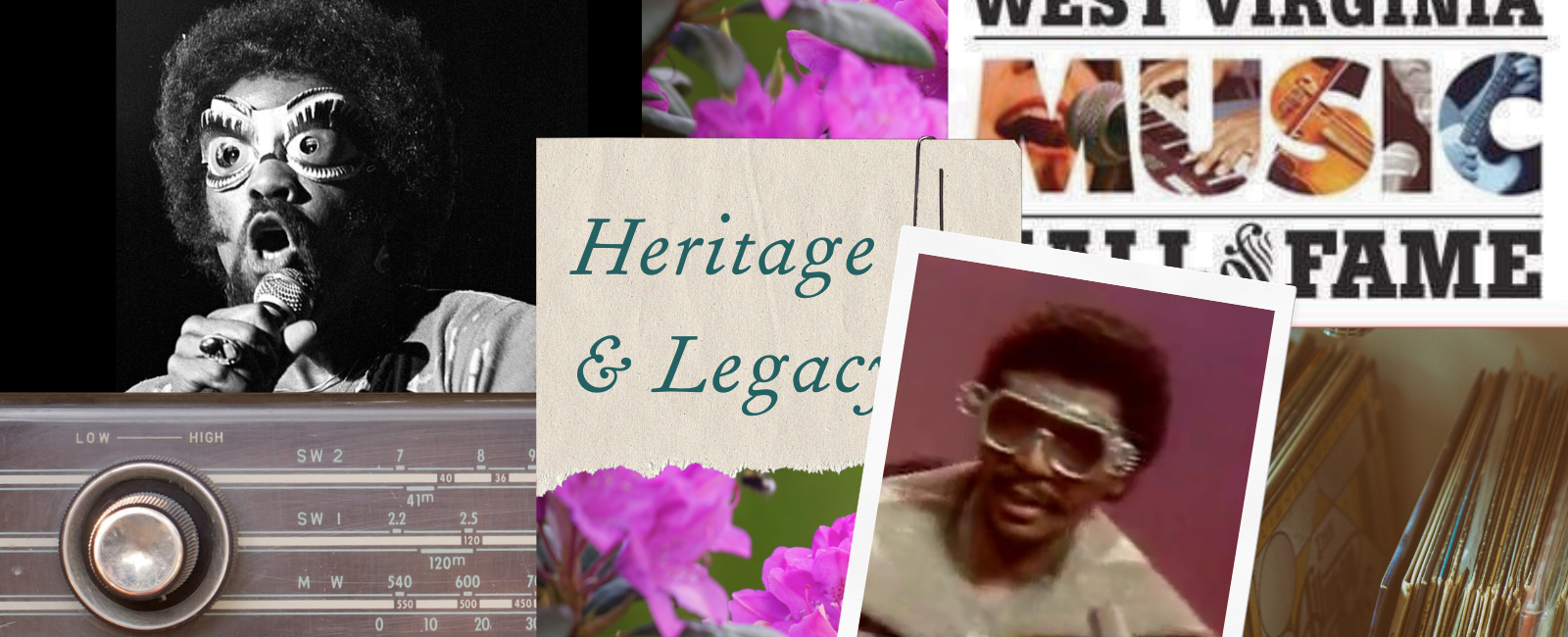
7. Calvin Simon, color photo with him in “stage glasses”, small inset of Calvin in left corner. Source. YouTube.
8. Color photo of Calvin Simon in front of a case with a Grammy. Taken in 2019, when members of the P-Funk received a personal Grammy-Lifetime Achievement Award.
9. Two of Fuzzy Haskins. Source: Discog. One b&w he’s wearing “bug” glasses. Two, color picture of him in the zone. Rolling Stone.