West Virginia Music Hall of Fame, Class of 2020
Mountain State Maestro and Musical Ambassador
Mountain Stage Turning Point
April 28, 1991
The Day the #1 Band in the World, Played in Charleston, WV, on Mountain Stage.
Charleston, West Virginia was buzzing. R.E.M. was coming to town to play on its locally-produced, state-owned, semi-underground performance show, Mountain Stage, at a time when the band was at the peak of their popularity as the number one band in America. Some called R.E.M. the biggest band in the world at the time, and they were just about to release their 7th album, Out of Time, featuring the signature song “Losing My Religion”.
By this time in his career, Mountain Stage co-founder, artistic director, and on-air host, Larry Groce, a Texas transplant, had lived in West Virginia almost 20 years, coming to the Mountain State in 1972. In 1976 he achieved two career milestones. First, he received a Grammy nomination for his first Disney label recording Winnie-the-Pooh For President, in the category of “Best Recording for Children”. (Between 1976 and 1990, Groce performed on nine Disney albums, one of which was certified gold and five certified platinum.). Also in 1976, Larry Groce had a national top ten record, with the clever “Junk Food Junkie” reaching #9 on the Billboard charts.
But neither of those stellar, individual achievements meant as much to Groce as the work he had been doing since 1983 in developing and delivering Mountain Stage – a two hour, live music, radio show for West Virginia Public Broadcasting and carried by National Public Radio (NPR). The show was known for its eclectic lineups of musical acts from all genres. In its first eight years with NPR, Mountain Stage slowly but steadily grew, reaching 100 stations nationwide by the time of R.E.M’s appearance in 1991.


How does a show like Mountain Stage land a world renowned alt-rock band at the height of its powers. How is that possible? Larry Groce has been asked that question many times. He responds truthfully and with a big grin. “R.E.M. called us.”
Turns out R.E.M. guitarist Peter Buck had performed on Mountain Stage in 1990 as a band member for friend Kevn Kinney. Buck enjoyed the experience, telling Groce afterward, “It was a great show. I had fun, I’ll bring my band back sometime.” Groce was happy that Buck was happy, but R.E.M. on Mountain Stage? Yeah, right.
Let’s cut to R.E.M. headquarters in Athens, Georgia, the fall of 1990. The band was about to release their seventh album, but had no plans to tour behind Out of Time. Instead they were going to make three, select media appearances. “Saturday Night Live” was already booked, as was an appearance on MTV’s “Unplugged”.
During a brainstorming session in Athens, with their label, Warner Brothers, the band suggested Mountain Stage as the third national appearance for R.E.M. Making the case for the show was R.E.M.’s manager, Bertis Downs, originally from Montgomery, WV. Downs, a University of Georgia Law School graduate, has said, “I had known about the show. I was born in West Virginia and my roots are there. I thought Mountain Stage was a neat show. I also knew it was a little unconventional, not a typical move for a rock band to make. I thought it would be fun.” Downs convinced Warner Brothers that Mountain Stage would be right for R.E.M.

It was Downs who then reached out to Andy Ridenour, Mountain Stage’s co-founder and executive producer, hoping to book the band in the spring of 1991. Ridenour was sure he was being pranked, but eventually business was done, and the band was booked. For this special show, Mountain Stage would move from the Cultural Center to the 1,000 seat, Capital Plaza Theater.
With the band’s blessing, it was decided to make the show a fundraiser for Mountain Stage. Groce has said, “We charged $20 a ticket, at a time we were charging $3 per person or $5 for a family ticket.”
Andy Ridenour remembers, “The pressure on the show was immense, not from R.E.M., but from the outside. The ‘Today Show’ did a piece on us. Rolling Stone magazine called and ran a blurb about how Mountain Stage was a ‘unique radio program with promise’. Over 50 reporters from all over the world came to Charleston just to cover R.E.M.’s performance on Mountain Stage.” He continues, “We sold out a 1,000 seat auditorium in nine minutes! Scalpers were charging outrageous amounts for tickets.” The band played to a full house, and things changed for Mountain Stage. The music magazine No Depression has claimed that R.E.M.’s Mountain Stage appearance became the most bootlegged show in the history of live radio.
Even many years later, the significance of that show is not lost on Larry Groce. “That one show was a game changer for us. What R.E.M. did was put us on the map. We were on about 100 stations then, and now it’s north of 280 NPR affiliates carrying the show, and most of that growth occurred within two years of R.E.M. appearing on Mountain Stage.”
From this point forward, the Texas kid who found his “forever home” in West Virginia, was on a mission to grow the show, keep it interesting, and let people all over the world know about the virtues of West Virginia.

TEXAS
Larry Groce was born on April 24, 1948 in Dallas, Texas where he spent the first 18 years of his life. He attended Adamson High School from 1963-67. At the time, the school was loaded with singer songwriters, who would all go on to some level of national fame. Besides Groce, graduates from those years included Michael Martin Murphy (“Wildfire”), Ray Wylie Hubbard (“Up Against the Wall Redneck Mothers”), and B.W. Stevenson (“My Maria”).
The first of his 24 albums was a recording of hymns, recorded in 1969 while he was still in college. Peace and Joy and Power was co-produced in Nashville by bandleader and comedian, Kay Kyser.
In 1970, at 22, Larry moved to New York City and became a regular performer at Focus, an organic food restaurant on the Upper West Side. He later incorporated some of that experience in his hit “Junk Food Junkie”. After a short stay in Los Angeles in 1971, where he had a regular gig at legendary folk club “McCabe’s” in Santa Monica, Groce moved again, this time to West Virginia.

WEST VIRGINIA
In a 2024 interview with Michael D. McClellan, Groce shared, “By 1972 I was looking for something else. When out of the blue I get a phone call from the National Endowment of the Arts (NEA) asking me if I’d like to go to West Virginia as part of the NEA’s new program called ‘Artists in the Community’. I couldn’t believe it. This was not a program I had ever heard of, let alone, applied to for acceptance. I could only think Kay Kyser had something to do with this.”
Groce thought they wanted him to go to West Virginia for a week and be an artist in residence. But he learned it was a nine month gig and commitment. He decided the change would do him and his wife good. Larry told Todd Burge, “The money was excellent, so I took the job. What I had been doing before was playing music for college people in bars and clubs, and now I had to learn how to go into schools and work with children, and go into communities and be of assistance. We had a small budget so I could buy instruments for schools and individuals. I was in three counties, Barbour, Tucker, and Randolph. My wife and I decided to live in Barbour County, around Philippi. I lived there from 1972 to 1997, and then moved to Charleston.”
Although the NEA job was over in nine months, the people in Randolph County wanted Groce to stay and continue his work. They raised enough money so he could continue his mission in West Virginia. He remembers, “I traveled all over. Some days I would drive 100 to 120 miles from Philippi to Hendricks in Tucker County, down to Valley Bend in Randolph County, and then back home. That’s when I fell in love with West Virginia.”

JUNK FOOD JUNKIE
During this time Groce had written a song that always got a good response everywhere he played. At the time, “Junk Food Junkie” did not interest any record labels so he and his manager decided to put out the song as a single. It was very popular with DJs and got a lot of airplay. So much so the Warner/Curb label stepped in and offered Groce a contract. The satiric novelty song eventually rose to #9 on Billboard’s Hot 100 Chart in the spring of 1976.
The song’s success generated feature articles in the New York Times, and People Magazine. It led to Groce making television appearances on The Tonight Show, The Merv Griffin Show, The Midnight Special and Dick Clark’s American Bandstand.

MOUNTAIN STAGE
In the early 1980’s West Virginia Public Radio was planning to expand its number of West Virginia affiliates from two to thirteen. Part of that plan was to also generate new and original programming. When Executive Producer Andy Ridenour and Chief Engineer Francis Fisher were conceiving the program they asked Larry Groce to be their Artistic Director and on-air Host. He readily accepted. They did a pilot program that aired in 1981 but it took two more years to get the money to make any more shows. According to Groce, “In December of 1983 we began doing a show once a month. We did twelve shows in 1984, sixteen shows in 1985 and in 1986 we went national.”
Larry Groce’s musical tastes have been instrumental in defining the sound of the show. For many important musical artists, Mountain Stage was the first nationally broadcast program on which they appeared. Artists making their national debuts on Mountain Stage include Lyle Lovett, Mary Chapin Carpenter, Sheryl Crow, Barenaked Ladies, Phish, Counting Crows, Ryan Adams, Lucinda Williams, Alison Krauss, and the Avett Brothers, to name just a few. The show has also featured musical pioneers such as Bill Monroe, Ralph Stanely, Doc Watson, and Pops and Mavis Staples. Groce retired from hosting Mountain Stage in 2021. His successor is Kathy Mattea.
“No question, the founding of the Mountain Stage radio program has been a gift to me, but I hope the show’s biggest effect has been to help raise the profile of West Virginia among music lovers all over the world. When you’re from West Virginia, you know at the start, you are an underdog. Anytime our show can help break a stereotype about the state, I’m happy to do that.” Larry Groce.
In 2016 Groce released his first recording in 27 years, Live Forever, with his wife, violist Sandra Groce. It includes the full version of the Mountain Stage theme song, “Simple Song”.
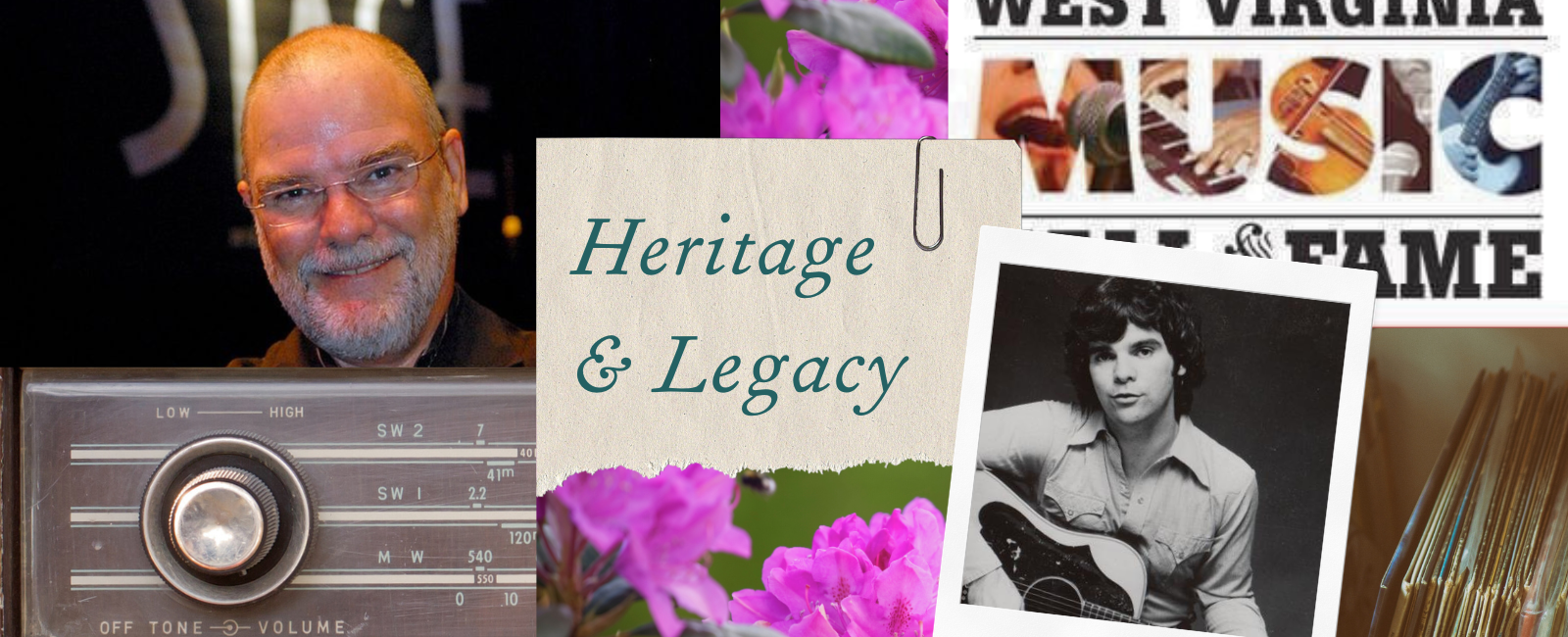
In 2017, Larry Groce was named the West Virginia of the Year by the Charleston Gazette-Mail, and in 2020 he was inducted into the West Virginia Music Hall of Fame
Larry Groce received an Honorary Degree from West Virginia University in 2022 by WVU President Gordon Gee committed, “The show is a true calling card for our state thanks to Larry’s vision and persistence.”
Groce was inducted in the Folk Radio Hall of Fame by Folk Alliance International in January of 2024.

Random Notes:
*In 1990 Larry Groce starred in the movie Paradise Park, written and directed by West Virginia film maker Daniel Boyd. (It was later released as Heroes of the Heart.) A film about life in a Mountain State trailer park, Groce co-wrote the title song with Webb Wilder, who also appeared in the film with country musicians Porter Wagoner and Johnny Paycheck. Groce and Boyd also wrote a successful musical theatre version of the film in 2018.
*From 1990 until 2004, Groce was part owner of West Virginia’s only statewide arts and entertainment tabloid, Graffiti.
*In 2005 he became the executive director of FestivALL Charleston, a 10 day festival of music, dance, theater and visual arts in West Virginia’s capital city Charleston.

SOURCES:
Interview with Todd Burge, 2000.
“15 Minutes With…” Larry Groce Interview with Michael D. McClellan.2024.
Quarrier Street Records. Larry Groce Biography.
“Mountain Stage: An Oral History” Glenn Cook. 2024.
Photos Sources: Mountain Stage and WV Public Radio
RECOMMENDED LISTENING – by the author.
1. “Simple Song (Theme from Mountain Stage)”. Every Mountain Stage show, all 900+ that they have aired so far, begin with this warm and welcoming tune written and performed by Larry Groce.
Simple Song (Mountain Stage Theme) (Live) – YouTube
2. “When the Mist Clears Away” – Another Groce composition, it has become one of this writer’s favorite songs, evoking the West Virginia eco-system and lifestyle. Turn it up.
3. “Junk Food Junkie”. This clever, novelty song hit the national top 10 Billboard Chart in the spring of 1976.
Larry Groce Junk Food Junkie – YouTube
____________________