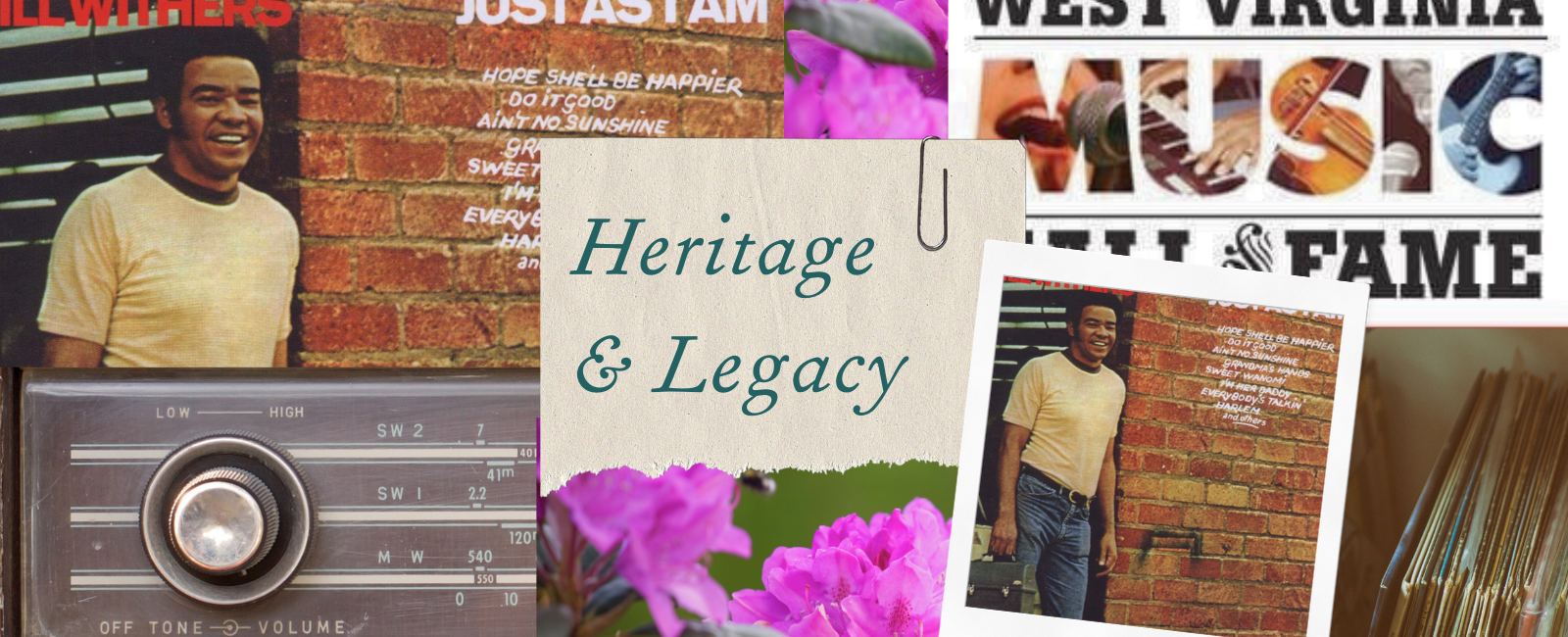
Bill Withers (July 4, 1938-March 30, 2020),
West Virginia Music Hall of Fame, (WMHOF) Class of 2007.
In the fall of 1974, a three-day music festival was held in Africa as part of the promotional events surrounding the heavyweight boxing championship match between Muhammad Ali and George Foreman, known as “The Rumble in the Jungle”. In addition to promoting the Ali-Foreman fight the festival, known as ZAIRE 74, was intended to present and promote racial and cultural solidarity between African Americans and African people. Over thirty performers came from all over the world. The American delegation featured top R&B and soul artists such as James Brown, Etta James, The Spinners, and B.B. King.
Among the U.S. featured headliners for this international festival was a 36-year-old West Virginian who just three years earlier had been making a living as an aircraft mechanic installing toilets. Raleigh County’s Bill Withers performed in front of 80,000 people at ZAIRE 74 and many reviews of that historic festival point to his performance as a highlight. At one point in the show as his band takes a break, Withers and his acoustic guitar take command of the outdoor arena stage, and he delivers a powerful performance of the deep cut song “Hope She’s Happier with Him”. BILL WITHERS LIVE, ZAIRE 1974 (youtube.com)
Who is this powerful music man from West “by God” Virginia?
William Harrison ‘‘Bill’’ Withers Jr. was born on the Fourth of July 1938, into a miner’s family of 13 children in tiny Slab Fork, Raleigh County West Virginia. His mother moved the family to Beckley when Withers was three, but he continued to spend weekends in Slab Fork. By the time he was 15, Withers was singing with gospel groups in the Beckley area. A solid baseball player, in the 1950’s he spent a summer playing professional baseball in the Negro League. At age 17 he joined the U.S. Navy and then spent nine years as an airline mechanic in the service. He was discharged in San Jose California in 1965 and then moved to Los Angeles where he took a job at a Lockheed factory installing toilet seats and air stairs on 747 jets.
He still was writing songs and going to see performers who influenced him like the great Lou Rawls, and harboring thoughts of being a professional songwriter who might also perform. In 1967 he cut a version of his song “Harlem” but it went nowhere. He was nearing 30 years of age and thinking he may be too old to get started in the music business.


His demos continued making the rounds with one record executive who liked what he heard. Clarence Avant was forming a new label and wanted Bill Withers as an artist, singer and songwriter.
In 1970, Avant formed Sussex Records and introduced Withers to Booker T. Jones of the band Booker T. and the M.G.s famous for being the house band at Stax records in Memphis. After hearing his songs, Booker T. decided he wanted to produce the first album for this “new” artist”. Jones would later refer to Bill Wither’s as “the poet we didn’t have at Stax records”. In 1971, Withers released his first album, Just As I Am. The cover photo of the record shows him in blue jeans, carrying a lunch bucket, and was shot during his lunch hour at the Lockheed plant. Funny story. Withers was laid off in the course of making the album but, as he coyly puts it, “As things turned out, I didn’t have to go back.”
“Ain’t No Sunshine” went to #3 on the pop charts and won a Grammy for Best R&B Song, though this was a bit of a surprise since the intended single was A-side, “Harlem”. Nationally DJ’s started flipping the A-side over and finding the B-side, “Ain’t No Sunshine” got a better reaction from listeners. A hit single was made, and Bill Withers, at age 33 was on his way to greatness.
His second album Still Bill was recorded and produced by Withers with musicians from the Watts 103 Street Rhythm Band. It also features some of Withers’ most popular songs, including the hit singles “Lean On Me” and “Use Me”. A commercial and critical success at the time of its release, Still Bill has since been regarded by music journalists as a highlight of the singer’s recording career and a classic of 1970s R&B.
His performance at Carnegie Hall on October 6, 1972, was recorded and released as the live album Bill Withers, Live at Carnegie Hall on November 30, 1972. It has been ranked as one of the best live albums of all time by critics such as Greg Kot and Jim DeRogtis. After the Sussex record label folded, Withers signed with Columbia Records in 1975. He won a Grammy in 1982 for ‘‘Just the Two of Us,’’ and another in 1988 for ‘‘Lean on Me,’’ re-made that year by the band Club Nouveau.
Writing for The New York Times, Giovanni Russonello calls Withers “a soulful singer with a gift for writing understated classics,” adding, “the ultimate homespun hitmaker, he had an innate sense of what might make a song memorable, and little interest in excess attitude or accoutrement. Ultimately, Withers reminded us that it’s the everyday that is the most meaningful: work, family, love, loss.” A Billboard article considered that Withers “stands as one of R&B/soul music’s most revered singer-songwriters.”
Bill Withers was inducted into the Songwriters Hall of Fame in 2005 and into the West Virginia Music Hall of Fame in 2007. He was inducted into the Rock and Roll Hall of Fame at an April 18, 2015, ceremony in Cleveland. In 2017, West Virginia University awarded him the honorary degree Doctor of Music from the College of Creative Arts. Bill Withers died in Los Angeles from heart complications. He was 81. In 2021 the West Virginia Department of Transportation renamed Slab Fork Road from the Lester Highway to the Coalfields Expressway in Raleigh County as “Bill Withers Memorial Road.”

As a singer he always had a warmth to his vocals that managed to convey endurance, while perching right on the edge of breaking. He had great timing and delivery. He was a natural shouter who raised his voice judiciously, and always in service to the song.
Here is some of his music I recommend.
- Just As I Am (1971): His first album. Produced by the great Booker T. Jones. The opening trio of songs, “Harlem”, Ain’t No Sunshine”, and “Grandma’s Hands” is about as good as it gets. Booker T. brought along two of the MGs, bassist Duck Dunn, and drummer Al Jackson to make this record. Though MGs guitarist Steve Cropper wasn’t available, Jones was able to get rock superstar guitarist Stephen Stills to play for the session.
- Still Bill (1972): His biggest hit, “Lean On Me”, begins with Withers playing a simple chord progression that recalls the church hymns of his youth and his coal camp beginnings. I’ve always loved the contrast between this song’s hopeful, helpful message and the album’s other hit single “Use Me”. That song is about taking advantage of people in relationships, and the tricky business of romantic give and take. “Use Me” shows off the band that Withers was using for this album. Drummer James Gadson and keyboard player Ray Jackson kick the song off with one of the funkiest grooves and hooks you’ll ever hear. That hook of keyboards, and sharp syncopated drumming interacting, carry the song. Part of its success is the tension it sets up with Wither’s smooth vocal delivery.
- Bill Withers: Live at Carnegie Hall (1973). The folk-soul singer from Slab Fork plays Carnegie Hall and the resulting live album is one of the best ever recorded. You can look at the cover of the album to see how, with stage lighting, they shrunk the stage of the famous hall and put the audience up close and personal with the artist. Deep cut here is “I Can’t Write Left-Handed”, a powerful song about a Vietnam vet who has returned to civilian life missing a limb. You won’t forget this song.
- Deep cut. “Soul Shadows” The Crusaders, featuring Bill Withers, from the Crusaders 1980 album, Rhapsody and Blues. Here Withers sings with the legendary Crusaders. While he didn’t write this song, it does show off his abilities as a vocalist.
Steve Goff is a past President of West Virginia Writers, Inc.; and his record reviews have appeared in national music publications such as Goldmine, Stereo Review, and Hit Parader. An avid music collector, he is still hanging onto over 8,000 pieces of recorded music, 6,200 of which are on poly-vinyl.