West Virginia Music Hall of Fame – Class of 2007.
“Well, the doctor comes ’round here with his face all bright And he says, in a little while you’ll be alright | All he gives is a humbug pill, a dose of dope and a great big bill | Tell me how can a poor man stand such times and live?” – How Can a Poor Man Stand Such Times and Live?
Blind Alfred Reed, December, 1929.
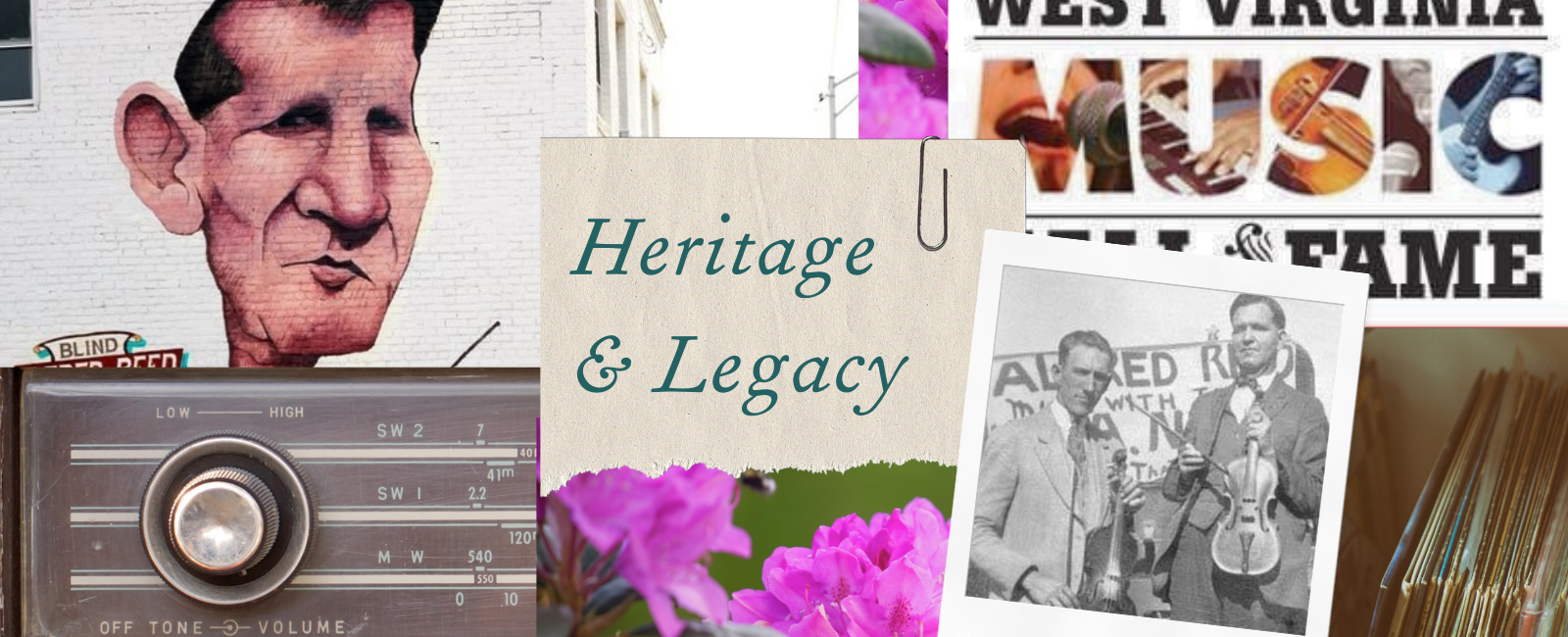
In 2007, Blind Alfred Reed was the first person inducted into the brand new West Virginia Music Hall of Fame. He was not alone, as nine other West Virginia musical legends including Little Jimmy Dickens, Bill Withers, and Hazel Dickens, were also enshrined that night as the first class of inductees. But Blind Alfred Reed went first, and all others deferred. He was described that night, and remains, “one of West Virginia’s little known musical treasures.” Simply called a “hillbilly artist” in the old days, critics and other artists have caught up with the work of this “Appalachian visionary”. Nowadays he is often characterized as a protest singer out of time and place, ingrained with an unusual sense of humor, humility and social conscience. The verse of “How Can a Poor Man Stand Such Times and Live?” included here, is a perfect example of that characterization. That verse, composed in 1929, could easily have come from a current song, commenting on our own life and times in modern day West Virginia.
Born in Floyd County, Virginia, in June of 1880, Alfred Reed lived most of his life in West Virginia. He called the Princeton area home, but also lived in Pipestem, Bluefield, and Hinton. Blind from birth, neither of his parents were musically inclined, but he learned to play fiddle, guitar, banjo, and mandolin at an early age. These abilities, combined with his singing and songwriting, enabled him to earn a living for he and his wife, Nettie, and their six children. He taught music lessons to young people, but most of his earnings came from performing at dances, meetings, and churches and occasionally from playing on street corners and in city parks for handouts. In a pre-welfare United States, music was one of the few means available to blind people to earn an independent income.


It was one of his own compositions that led to a two-year recording contract.
On May 24. 1927, a passenger and a freight train on the Virginian Railway collided head-on at Ingleside, WV, killing two and injuring twenty-nine. After hearing radio reports of the accident, Reed composed “The Wreck of the Virginian”, a song that became well known in the region. Soon Reed got a telegram from Ralph Peer, a touring talent scout for the Victor Talking Machine Company (later RCA Victor) requesting him to come to Bristol, VA/TN to record his song about the train crash. His recording session was scheduled for July 28, 1927. A friend drove him to Bristol and they soon found the second floor makeshift “recording studio” Ralph Peer had put together on State Street, in downtown Bristol. Reed recorded three religious songs besides his train wreck ballad. Very quickly all four songs started selling well locally, so eventually Ralph Peer had Reed sign a recording contract with the Victor Company. It was Ralph Peer who made sure that Alfred Reed would now be known as the artist “Blind Alfred Reed”.
Throughout the summer of 1927 Peer recorded a host of “hillbilly” artists in Bristol. Many have come to call the 1927 Bristol Sessions, the “Big Bang of Country Music”. They have a case. These sessions also captured the first recordings of the Carter Family (the first family of Country Music) and Jimmie Rodgers.(the father of Country Music) and many others.

Reed subsequently had two more recording sessions for the Victor label. Unlike his first session when he accompanied himself, in these sessions he had his son Arvil on guitar and Fred Pendleton on second fiddle. Back home in Princeton, the three of them played together as the “West Virginia Nightowls. Six songs were recorded in Camden, NJ in December of 1927, including “Always Lift Him Up & Never Knock Him Down”, his hometown’s favorite song; and a critique of the popular flapper hairstyles “Why Do You Bob Your Hair, Girls?”. Two years later, in December of 1929 Reed and his son Arvil were in a studio for their last recording session, this time in New York City. Eleven new songs were recorded, including “How Can a Poor Man Stand Such Times and Live?”, and “Money Cravin Folks”.
As a recording artist Blind Alfred Reed’s career lasted only a little over two years, but every one of his songs has significance. Most Reed songs contain valuable social commentary which helps in understanding the philosophy of mountaineers like Reed himself and his neighbors who purchased and treasured his records and song-sheets. His recording career was off to a good start. And then came the stock market crash of 1929.
The Depression took its toll on the brand new record industry, and it ended Blind Alfred Reed’s recording career. He continued to play music for several years thereafter in Princeton with his son and other musicians. In 1937 local municipal authorities in West Virginia started enforcing “no begging” statues which prohibited blind musicians from playing on the street. By the 1950’s his recordings had been unavailable for more than twenty years, which reduced his modest royalties to a trickle.
He was all but forgotten until the folk music revival in the late ’50s early ’60s when the influential “new folk” group, The New Lost City Ramblers recorded a few of his songs in 1959.
There are only twenty-one songs written by Blind Alfred Reed, but many of those songs are sung today. Diverse musicians over the years –rock legends like Ry Cooder, Bruce Springsteen, and David Lindley, respected popular music acts like UB40, Old Crow Medicine Show, and the Del-Lords–have interpreted Alfred’s songs for new generations. See the “Recommended Listening” feature of this article for more information about the songs and music of Blind Alfred Reed.
Alfred Reed died at the age of 75 on January 17, 1956, in his home at Cool Ridge in Raleigh County, WV. During the late 1950s and early 1960’s urban folk music revival, a rumor circulated among some younger musicians that suggested Blind Alfred Reed had died of starvation. Ry Cooder himself used to tell this story. However, the Reed family has insisted that in his last years Alfred was comfortable and content and he was buried beside his wife, in Mercer County, West Virginia.
Blind Alfred Reed. Always lift him up.
- Blind Alfred Reed: Complete Recorded Works in Chronological Order. 1927-1929. Since Reed only recorded twenty-one songs in his short recording career, everything he did is on this recording from Document Records. However, like a lot of music recorded in the 1920’s, the sound quality takes some getting used to, but it’s worth the effort to hear the man himself deliver these songs with the best sonics available at the time. Even with some hiss and crackle, you can’t miss Reed’s talent for writing a popular song.
- Always Lift Him Up: A Tribute to Blind Alfred Reed. Various Artists – 2008. The WV Music Hall of Fame (WMHOF) got into the recording business when Tim O’Brien and some friends put together this fantastic Blind Alfred Reed tribute album. The CD features exclusively West Virginia singers, pickers, and fiddlers such as WVMHOF fellow members Little Jimmy Dickens, Kathy Mattea, Nat Reese, Connie Smith, Johnny Staats, Charlie McCoy and Larry Groce. The sonics are modern and the songs receive rich and full treatments. *This CD is hard to find and not on Spotify or Youtube. The WVMHOF carries it on their website for $15 plus shipping. You can also pick one up while visiting the WVMHOF museum location at the Town Center in downtown Charleston, WV.

- How Can a Poor Man Stand Such Times and Live?” After listening to Reed’s version of this powerful song, from 1929, check out these two cover versions. One: Ry Cooder on his first album, 1970, introduced the rock and roll generation to the music of Blind Alfred Reed by covering this song. Two: Bruce Springsteen covered this classic when he was touring with his Seeger Band in 2006, playing primarily songs by Pete Seeger. Here is a video of Springsteen performing the song that same year at the New Orleans Jazz & Heritage Festival. Note his shout out to Blind Alfred Reed as he introduces the song. Reed wouldn’t recognize the arrangement, but it is perfect for a Jazz Fest crowd.