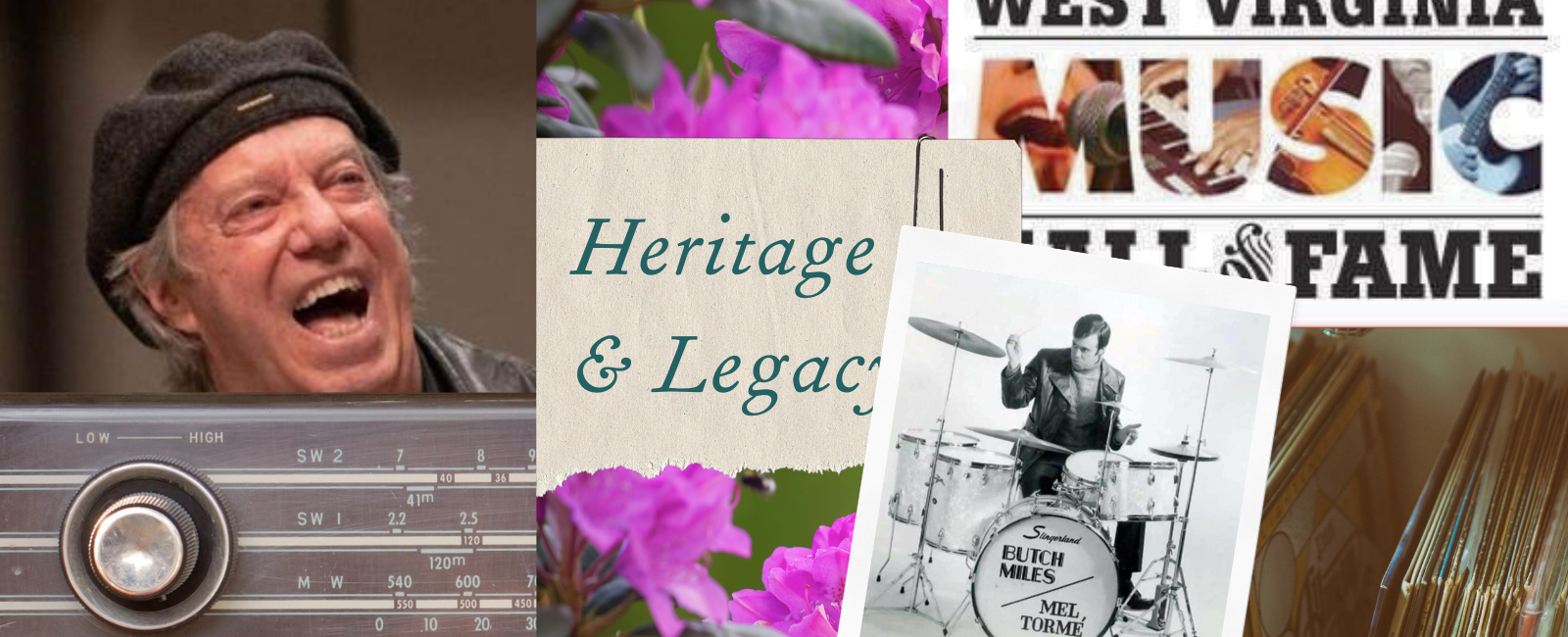
West Virginia Music Hall of Fame – Class of 2011.
The Virginia Beach Jazz Festival: August 1960
Jazz drummer extraordinaire and natural-born storyteller Butch Miles often cited Saturday, August 20, 1960, as the most important day of his life. That was the day the musically talented 16-year-old high school student saw professional jazz musicians performing live for the first time. He and his mother had made the long trip from Charleston, West Virginia, to Virginia Beach for the city’s jazz festival. They stayed overnight so they could catch the music on both Saturday and Sunday.
The festival lineup, which included Dave Brubeck and the Charlie Byrd Trio, opened Miles’s eyes to new artists he would come to love. However, Butch was there primarily to see one Saturday act: Count Basie and His Orchestra. As a drummer, Butch was desperate to see the Basie Band’s phenomenal Sonny Payne in person. Known for his power, precision, and ability to “swing” a band, Payne became the blueprint for the drummer Butch aspired to be.
As the Basie Band took the stage, Butch spotted Payne settling in behind his enormous drum kit. He remembers his mother giving him a knowing glance and a smile. Just then, the announcer barked: “Ladies and gentlemen! The most EXPLOSIVE FORCE in jazz: Count Basie and His Orchestra!”
BAM! Sonny Payne and his flying drumsticks took charge, and the Basie Band was off and running with a crowd favorite, “One O’Clock Jump.” In that instant, Butch Miles knew he was going to become a professional jazz drummer. He vowed to become so good that one day, he would play with the Count Basie Orchestra. This became his North Star. When he returned to Charleston, he quit his rock ‘n’ roll band and began the disciplined journey toward becoming a world-class jazz musician.

Detroit, Michigan: January 1975
Fifteen years later, Butch Miles was an out-of-work professional jazz drummer. He had just finished a three-year gig with the established singing star Mel Tormé but found himself in Detroit without a clear plan. While he landed occasional club dates and session work, his strategy of “rolling the dice” wasn’t quite panning out.
Then, out of the blue, came the phone call he had been waiting for since that summer day in Virginia Beach. His phone rang early on Tuesday, January 28, 1975. On the line was Sonny Cohn, the road manager and booker for the Basie Orchestra. Cohn explained that the band was in a bind; their current drummer had been in a serious car accident on Sunday night, and they needed a fill-in immediately. Cohn asked if Butch could replace the drummer for seven to ten days. If so, could he and his drums fly from Detroit to Chicago for an 8:00 p.m. show that night? Butch Miles could hardly believe his ears. He, of course, said yes.


That night, without a single soundcheck or rehearsal, the Count Basie Orchestra took the stage. The announcer took the microphone: “Ladies and gentlemen! The most EXPLOSIVE FORCE in jazz: Count Basie and His Orchestra!” And on drums, leading the way, was 30-year-old West Virginia native Butch Miles.
While one might wonder how a debut show with no rehearsal would go, the results spoke for themselves. What was intended to be a 10-day replacement gig turned into a four-and-a-half-year residency. Count Basie simply loved Butch Miles.
From the drummer’s throne of the Basie Band, Miles proved to the world he was a true force of nature. After leaving the band in 1979, he recorded and toured with the Dave Brubeck Quartet for a year, gigged with the world’s finest big bands, and recorded several solo projects.
In 1997, he was lured back to the Count Basie Orchestra for another ten-year run. Though the Count had passed away in 1984, the band maintained its global reputation for employing only the finest jazz musicians alive.
Over his illustrious career, Butch Miles performed or recorded with legends including Frank Sinatra, Tony Bennett, Rosemary Clooney, Sammy Davis Jr., Lena Horne, Woody Herman, Ella Fitzgerald, Benny Goodman, Gerry Mulligan, Zubin Mehta, Zoot Sims, Itzhak Perlman, and Willie Nelson. He recorded over 100 albums and played on four Grammy-winning projects.
Born on the Fourth of July
Butch Miles was born on July 4, 1944—an eventful day from the start. That morning, his mother and several family members began a two-hour drive from Summers County, West Virginia, to a family reunion in Russell, Kentucky. Though she was two weeks from her due date, she wanted to see her relatives. Butch had other plans. That afternoon, in a city park in Russell, his mother went into labor. The closest hospital was across the Ohio River in Ironton, Ohio. Two weeks later, she returned home to Hinton, West Virginia, as a single mother with a healthy newborn son.

Though born in Ohio, Butch was raised entirely in West Virginia. His birth name, Charles J. Thornton Jr., was a name he never used; it came from a father who was never involved in his life. The name “Butch Miles” was a combination of his mother’s nickname for him and her maiden name.
His mother instilled in him a love for big band dance music, playing Glenn Miller and Harry James records on repeat. Miles once recalled, “My mother loved to play those big band jazz records and dance all over the living room. When Gene Krupa would take a drum solo on a Benny Goodman tune, she would stop dancing and make sure I was listening closely to how well Krupa could play. I was listening.” Gene Krupa became Butch’s lifelong idol and a musical father figure.
In fourth grade, at age nine, he joined the school band in Hinton to play the snare drum. By the time he was in junior high, he and his mother had moved to Charleston. At 14, he bought his first drum kit, and at 15, he began formal lessons with Frank Thompson at the Guthrie & Dean Shop. He soon joined the musicians’ union and began playing professionally with local dance bands.
He briefly branched out into rock ‘n’ roll with a combo called The T-Birds, which played during lunch breaks at Charleston High School. However, Butch found the genre lacking: “Rock ‘n’ roll was kind of dull in 1960, especially if you were a drummer.”

The 1960 Virginia Beach festival was his life’s pivot point. His teacher, Frank Thompson, recognized his immense talent and steered him toward the music program at West Virginia State College (now University), where Butch earned his degree between 1962 and 1966.
After college, he joined the Iris Bell Trio, a successful Charleston-based jazz and blues outfit. The trio eventually moved to Ann Arbor, Michigan, serving as the house band at The Rubaiyat Supper Club for seven years. In 1971, he began his three-year stint with Mel Tormé. When Tormé took a hiatus from touring, Butch ended up in Detroit—setting the stage for the famous Basie phone call.
The call may have seemed “out of the blue,” but Butch had been recommended to Basie by two of the biggest names in music: Mel Tormé and the legendary Buddy Rich. As Butch told it, “One night before a show, Mel Tormé said to me, ‘Play your ass off tonight. Buddy Rich is out there.’” Butch did exactly that. When Rich heard Basie needed a drummer for a Chicago gig, both he and Tormé called the Count to vouch for Miles.


To survive that first high-stakes show without a rehearsal, Butch relied on his lifelong fandom. “Going into the first show with Basie, I already knew so many pieces by heart—‘Cute,’ ‘One O’Clock Jump,’ ‘Whirlybird,’ ‘Corner Pocket,’ and more.” For the arrangements he didn’t know, he listened for band members to shout out the chart numbers. “Thank God I could read music,” he said. “That saved me.”
The next morning at breakfast, Count Basie turned to Sonny Cohn and said, “Did you hear how well that drummer played last night? I can’t let him go.” It turned out the injured drummer would be sidelined for six months, and Basie hired Butch full-time.
In his 1986 autobiography, Good Morning Blues, Count Basie remembered him fondly: “Butch Miles came to us from Mel Tormé’s outfit. He was a real crowd-pleaser, like Buddy Rich and Sonny Payne, and he picked up on things quickly and added his own touches. He was a great fit for our band and a wonderful human being.”


A Lasting Legacy
In addition to headlining every major jazz festival in the world, Butch enjoyed a run of celebrity appearances in the 1980s. He appeared on 60 Minutes, The Tonight Show Starring Johnny Carson, The Merv Griffin Show, and The Dick Cavett Show. He also served as a member of the house band for six national broadcasts of the Jerry Lewis MDA Telethon and appeared as a musician in Woody Allen’s 1989 film, Crimes and Misdemeanors.
In 2007, looking to lighten his travel schedule, Butch joined the faculty of Texas State University to teach in their jazz program. He and his wife, Linda, settled in Buda, Texas. In 2011, he was inducted into the West Virginia Music Hall of Fame.
In March 2014, Miles was diagnosed with an incurable lung disease. He underwent a successful lung transplant and spent several years in recovery. Butch Miles passed away in Austin, Texas, on February 2, 2023, at the age of 78.
Today, his legacy lives on through the Butch Miles Jazz Festival, held annually on the campus of Texas State University in San Marcos.


Recommended Listening
- “Left Hand Funk” – The Count Basie Orchestra w/Butch Miles. From the 1979 album Live in Japan. Butch Miles has said that the album captures his playing with Count Basie at its best. Check out the funky stick work on this one. Count Basie & His Orchestra 5/21/1978 “Left Hand Funk” | Butch Miles, Eric Dixon | Live in Japan
- “Sing, Sing, Sing” – Butch Miles playing with The Great American Swing Band – 1992. This Benny Goodman classic gets the Butch Miles treatment. Sing, Sing, Sing – Butch Miles 1992 – YouTube
- “Wind Machine” – 1992. Watch how Butch’s personality comes through as he interacts with the pianist. Both listening closely to each other and pushing the tune forward. Wind Machine – Butch Miles 1992 – YouTube
- “Whirly Bird” – The Count Basie Orchestra, featuring a Butch Miles solo. The North Sea Jazz Festival 1979. Count Basie & His Orchestra 7/13/1979 “Whirly Bird” Butch Miles Drum Solo | North Sea Jazz Festival – YouTube
Sources:
Austin Jazz Society. “Hall of Fame Honorees: Butch Miles.” Austin Jazz Society. 2017. https://austinjazzsociety.org/butch-miles.
Miles, Butch. “Biography.” Official Website of Butch Miles. https://butchmilesdrummer.com/biography/.
Modern Drummer. “In Memoriam: Butch Miles (1944–2023).” Modern Drummer Magazine, February 3, 2023. https://www.moderndrummer.com/2023/02/butch-miles-1944-2023/.
West Virginia Music Hall of Fame. “Inductee: Butch Miles (2011).” West Virginia Music Hall of Fame. https://www.wvmusichalloffame.com/hof_miles.html.
Carmichael, Judy. “Butch Miles.” Judy Carmichael’s Jazz Inspired, episode 20. Podcast. https://www.jazzinspired.com/.
Roberts, Matty. “Butch Miles.” Percussion Discussion Podcast, episode 1. April 27, 2020. Podcast, 1:15:37. https://percussiondiscussion.buzzsprout.com/.
Wiggs, Christian. “Butch Miles.” Off the Bandstand, episode 55. September 17, 2021. Podcast, 1:24:04. https://www.christianwiggs.com/offthebandstand.
Photo Credits:
1) Photos 1-3. Black & White of “young” Butch behind his drum kit. Includes “Mel Torme” kit. ButchMiles.com
2) Photos 4-5. B&W of Butch Miles playing with Count Basie and his Orchestra (1977-78) . ButchMiles.com
3) Photos 6. B&W. Butch as a member of the Dave Brubeck Quartet. 1979. ButchMiles.com
4) Photos 7-9. Color of an “older” Miles. WV Music Hall of Fame.
5) 10-13. Various Album covers and one add for a drum maker. Discogs/Wikipedia.